
Building Safe Agent Tools Over a Seat Map API
The dangerous version of seat-booking AI is one bookSeats call with a secret behind it. Typed, scoped tools with holds and an approval gate.

13m

The dangerous version of seat-booking AI is one bookSeats call with a secret behind it. Typed, scoped tools with holds and an approval gate.

MEE6 and BotGhost are excellent for moderation and leveling. But if you need a Discord bot that queries your database, creates Stripe invoices, or looks up CRM records — that's a different category. Here's the discord bot maker that covers it.

Build a Discord AI bot that queries your database, calls Stripe or Zendesk mid-chat, and takes real actions — not just a ChatGPT wrapper. No code, 5-minute wizard.

Most Slack bots are notification pipes. This guide shows how to build a Slack bot that connects to real tools via MCP — querying live data, creating tickets, and running on every channel from a single bot definition.

An AI coding agent reads your repo, plans edits, runs tests, and opens a PR autonomously. The model is the easy part. Here is how MCP solves the tool-access problem that makes most coding agent setups break in production.

An autonomous AI agent uses an LLM to reason, call tools, observe results, and iterate toward a goal without human prompting each step. Here is how the loop works, what makes it safe, and how to build one.

42,000+ OpenClaw instances are exposed with no auth, plaintext credentials in config files, and unvetted MCP tools. Here are the real AI agent security risks — and the controls that fix them.

My agent ran 47 tool calls today. Here is every one, risk-scored. Plus: why your audit trail must live outside the agent filesystem — and the 2-minute morning review workflow that keeps me sane.

AgentOps is the emerging discipline for deploying, monitoring, and governing AI agents in production. Learn the six components — permissions, observability, approval gates, audit trail, cost control, and workspace isolation — that make agents safe at scale.

I asked my OpenClaw agent to clean up staging. It deleted 4,200 database rows instead. Here's the ai agent guardrails setup that made sure it couldn't happen again.
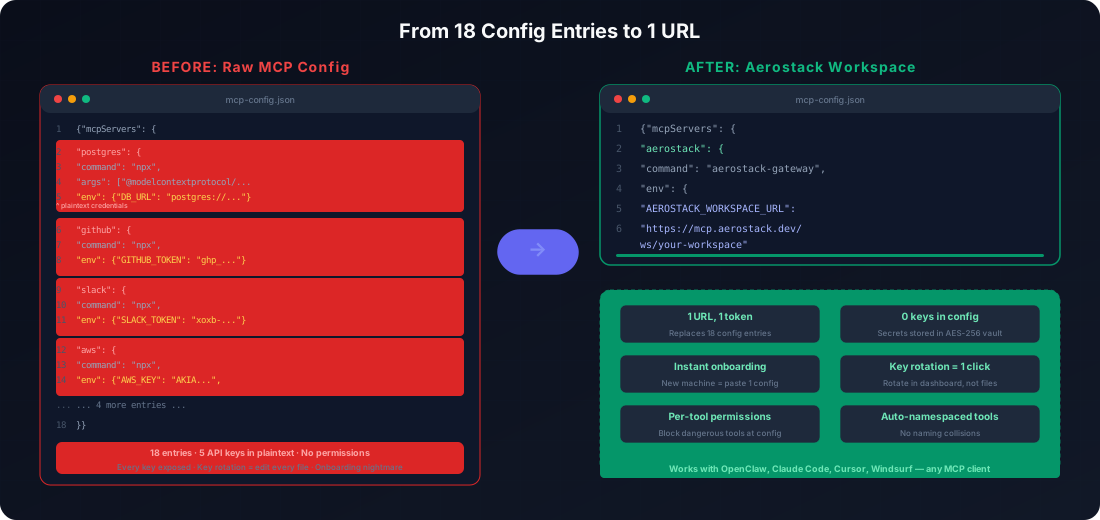
18 config entries. 5 API keys in plaintext. 2 hours to onboard. Or: 1 URL, 1 token, and a workspace that handles the rest.

The line between a chatbot and an AI agent is now mostly a question of how many MCP tools you wire in. Here's the real technical distinction — and why MCP-orchestrated bots cross it.

A practical guide to LLM cost optimization: confidence-based model routing, response caching, model tiering, and prompt token reduction. See the cost math for routing 100K queries per month across cheap, mid, and capable model tiers.

An MCP registry is a catalog of Model Context Protocol servers. Hosted registries like Aerostack go further — they run 254 servers for you, handle auth, and serve every tool to Claude, Cursor, ChatGPT, and Gemini through a single workspace URL.

AI agents can read, write, and delete anything you connect them to — yet most deployments have zero tool-level permissions. Here's what AI agent security actually requires, and how Aerostack enforces it.

An MCP gateway replaces per-machine MCP config with one authenticated URL. Set up Aerostack in 60 seconds: 254 hosted servers, AES-256 encrypted credentials, token-based access, and full audit logging.

30 concrete workflow automation examples using AI-native nodes: agent loops, confidence routing, guardrails, identity gates, and parallel execution — all running on Durable Objects.

Every tutorial shows you discord.js. Every no-code tool gives you preset commands. Neither can query your database. Here's how to make a Discord bot that's actually AI-powered — in 5 minutes of real work.

We built Aerostack because MCP configuration doesn't scale. Here's how we turned that into a platform where agents build infrastructure for other agents.