My first month running AI agents in production cost $340. I checked the dashboard three times. Three agents, two workflows, one very expensive lesson: spinning up capable AI agents is now trivial. Managing them once they are running is not. I had no cost caps, no audit trail, no kill switch. I had root-level access baked into every tool call and zero visibility into what was happening between the prompts.
That gap has a name: AgentOps. It is the emerging discipline, borrowed from DevOps and MLOps, that covers everything that happens to an AI agent after it is deployed. If you are running agents in any serious capacity in 2026, AgentOps is the difference between controlled infrastructure and a bill you cannot explain to your CFO.
What Is AgentOps?
AgentOps (short for AI agent operations) is the set of practices and frameworks used to deploy, monitor, and govern autonomous AI agents once they are live in production. IBM and Red Hat both published formal definitions of the category in 2026. The category emerged because AI agents, unlike traditional software, take actions: they call APIs, read files, write to databases, and spend money. That action-taking nature requires the same operational discipline we apply to servers and cloud infrastructure.
The shortest definition: AgentOps is to AI agents what DevOps is to software delivery. It closes the gap between the agent working in a demo and the agent being safe and cost-controlled in production. It also makes the ai agent management platform question tractable. Without AgentOps primitives, you cannot build a real control plane for agents.
The Infrastructure History Pattern
There is a pattern in infrastructure history. Every powerful abstraction goes through the same arc: raw adoption, then chaos, then management layer. And I find myself watching that arc play out in slow motion right now with AI agents.
Servers got Kubernetes. Code got Git. Containers got Docker. Infrastructure got Terraform. Git did not exist because version control was theoretically needed — it existed because Linus needed to coordinate thousands of Linux kernel contributors. Kubernetes appeared because companies running hundreds of containers were being destroyed by the manual approach. Terraform got built because clicking through cloud consoles at scale was causing outages and six-figure misconfigurations that nobody caught until the invoice arrived.
The management layer always arrives after adoption, never before. Nobody invests in management until the chaos becomes intolerable. AI agents are at exactly that inflection point. OpenClaw has 247K GitHub stars. AI coding assistants ship with every major model provider. Agent frameworks power production systems worth billions. And I have not found one of them — (not one) that ships a real management layer by default.
The AgentOps Lifecycle: Five Stages
A mature AgentOps practice covers five stages from first deploy to ongoing governance. Each stage answers a different failure mode that I have personally hit when running agents without a proper control plane in place:
Ad-hoc Agent Management vs an AgentOps Discipline
Most teams today manage agents the same way early DevOps teams managed servers: manually, inconsistently, with no shared state. Here is what that looks like compared to a proper AgentOps discipline in practice:
| Ad-hoc Agent Management | AgentOps Discipline | |
|---|---|---|
| Permissions | Agent gets full access to all connected tools | Per-tool, per-resource, least-privilege scoping |
| Observability | Final output only — no trace of reasoning or tool calls | Full session replay: every LLM call, tool invocation, error |
| Human oversight | None — agent acts autonomously on all actions | Approval gates for irreversible or high-risk actions |
| Audit trail | Local logs that get rotated or deleted | Persistent, searchable, tamper-evident history |
| Cost control | One runaway agent can spike the entire team bill | Per-agent token budgets plus model routing to cheaper tiers |
| Team isolation | Shared context across all users and agents | Workspace isolation: your agent cannot see my conversations |
| Kill switch | Kill the whole service or hope for the best | Instant per-agent revocation without downtime |
The Six Components of a Complete AgentOps Stack
An AgentOps stack is not one tool; it is six capabilities working together. I learned this the hard way by skipping most of them in my first production deployment. Here is what each one does and why skipping it causes real damage:
1. Fine-grained permissions. Not whether the agent has S3 access, but whether it has read-only access to this specific bucket prefix. Permissions scoped per tool, per resource, per agent. Composable and revocable.
2. Full observability. Real-time visibility into every step: LLM calls, tool invocations, self-correction loops, planning stages. Not just the final answer — the full trace. AI agent observability lets you rewind any run and understand exactly why the agent chose one tool over another. AgentOps SDKs track 400+ frameworks and provide session replay with point-in-time precision.
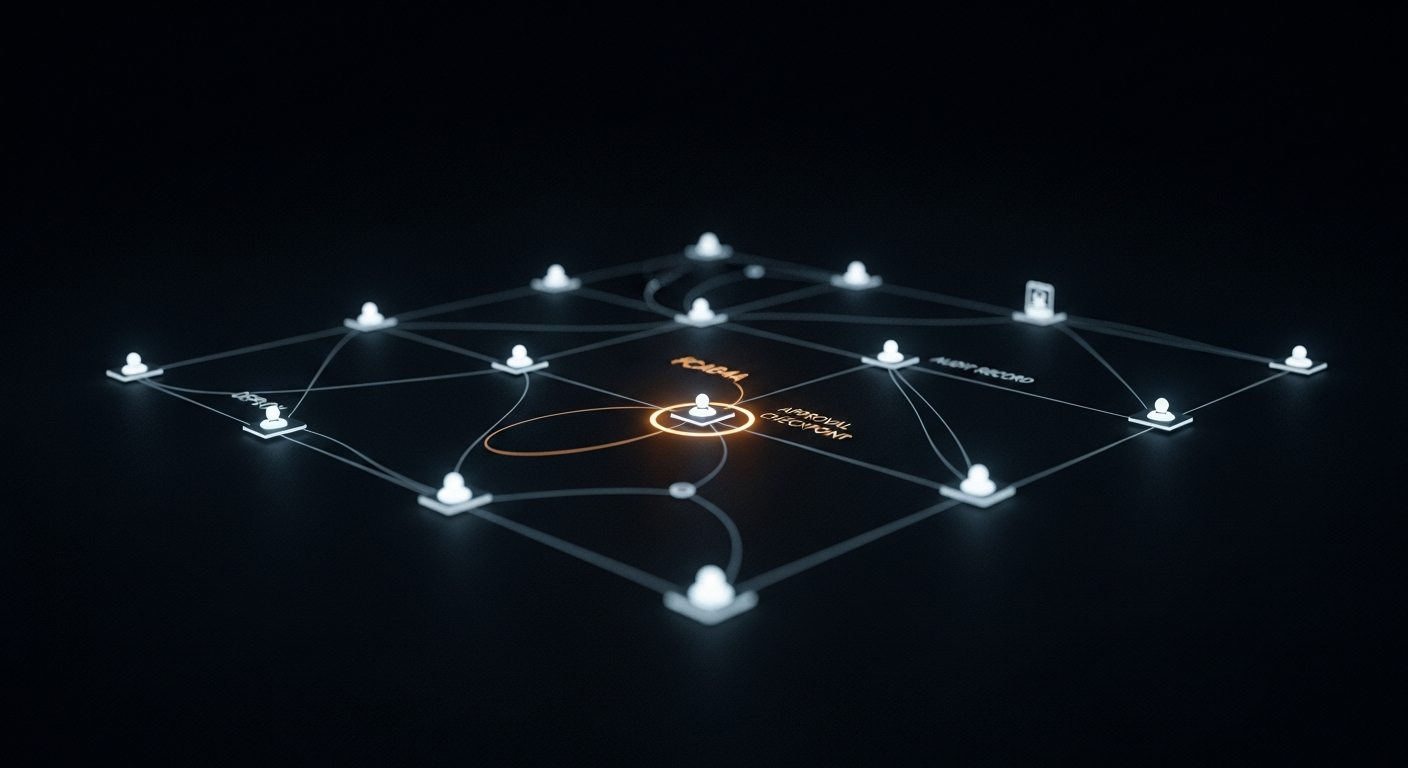
3. Human-in-the-loop approval. Before an agent deletes a database row, deploys code to production, or sends a message to your customers, a human reviews the pending action and approves or rejects it. This is the single most important safety feature in an AgentOps practice — and the most commonly skipped in early deployments. I skipped it. I regretted it.
4. Immutable audit trail. An independent, persistent log of everything the agent did, when it did it, why it made each decision, what it accessed, and what it changed. Not buried in local application logs that get rotated. Searchable and available for compliance review months after the fact.
5. Cost monitoring and model routing. Per-agent token budgets with hard caps. Automatic routing of routine tasks to cheaper models — expensive reasoning only where the task genuinely requires it. The 4.3x cost overrun on unmanaged deployments traces to one of three things: runaway context accumulation, wrong model for the task, or an agent retry loop nobody noticed until the invoice arrived.
6. Workspace isolation and instant revocation. Multiple people running agents in isolated contexts. Your agent cannot access my credentials. My agent cannot read your conversations. And when something goes wrong — and something will go wrong. A kill switch that stops a specific agent immediately without taking down the entire system.
Why AgentOps Must Be Framework-Agnostic
The deepest insight from the DevOps analogy: Kubernetes was not built by every cloud provider separately. It was built as a horizontal layer that worked across all of them. The same logic applies to AgentOps.
AI coding assistants, OpenClaw, LangChain, CrewAI, and the 200+ other agent frameworks in production today all face the same gap. They all give agents access to real systems with real consequences. An AI coding assistant has access to your codebase and API keys. There is no audit trail, no approval gate, no team context isolation. You hit run and hope.
An AgentOps control plane that works for only one framework is a plugin, not a control plane. The management layer that wins will be framework-agnostic: one place to govern all your agents regardless of what powers them.
How Aerostack Approaches AgentOps
Aerostack is built around the AgentOps lifecycle from day one. Rather than bolting governance on top of existing agents, Aerostack composes multiple MCP servers into a unified ai agent platform with permissions, approval flows, audit logs, cost tracking, and per-Workspace isolation built into the control plane. You run agents on top; Aerostack handles the governance layer underneath.
If you are running OpenClaw today, AI Agent Management: How I Took Back Control of My OpenClaw Setup shows the Workspace in practice. For the security angle, Your AI Agent Has Root Access covers exactly what happens when agents operate without permission scoping.
If you are new to the concept of agents themselves, start with What Is an Autonomous AI Agent? for the perceive-reason-act loop, or AI Agent Architecture for how the components wire together. Once you are building, AI Agent vs Workflow explains when to choose an agent over a deterministic automation.
AgentOps FAQ
Frequently asked questions about AgentOps
What is AgentOps in simple terms?
AgentOps is the discipline of managing AI agents in production — covering how you deploy them, monitor what they do, approve actions and control their costs. Think of it as DevOps but for autonomous AI systems that take actions in the world instead of just returning results.
What is the difference between AgentOps and MLOps?
MLOps focuses on the lifecycle of machine learning models: data pipelines, training runs, model versioning, and inference serving. AgentOps focuses on autonomous agents that use those models to take actions. MLOps asks whether the model is accurate. AgentOps asks whether the agent is safe and cost-controlled while acting autonomously.
Do I need AgentOps for a single-agent project?
For a one-off experiment: probably not. The moment your agent touches production data, costs real money, or involves more than one person on your team, AgentOps discipline pays for itself immediately. The 4.3x cost overrun on unmanaged deployments typically surfaces within the first 30 days.
What tools implement AgentOps?
The AgentOps-AI SDK provides ai agent observability across 400+ frameworks. Platforms like Aerostack provide a full control plane covering permissions, approval, audit and cost tracking in a single hosted service. LangSmith handles LangChain-specific tracing. The field is fragmented; no single tool covers all six components yet.
What is human-in-the-loop and why does AgentOps require it?
Human-in-the-loop means an agent pauses before taking an irreversible or high-risk action — deleting data, sending a customer email, deploying code to production — and waits for a human to approve or reject it. AgentOps requires this because autonomous agents can confidently take wrong actions. Without an approval gate, there is no checkpoint between the agent deciding to do something and that thing being done.
Is AgentOps the same as the AgentOps Python SDK?
No. The AgentOps Python SDK is one implementation of observability tooling for the AgentOps discipline. AgentOps as a broader ai agent management platform category covers permissions, approval flows, audit trails and workspace isolation. The SDK handles monitoring; a full AgentOps practice requires all six components working together.